Innova Hycross on Rent in Mumbai
Premium Hybrid (6 + 1 Driver) · Panoramic Sunroof · Airport, Local & Outstation · From ₹28/km | 24/7
Toyota Innova HyCross on Rent Mumbai — Quick Answer
Toyota Innova HyCross on rent in Mumbai starts at ₹3,000 (4 hours / 40 km local) and ₹5,000 (8 hours / 80 km). Outstation trips are ₹28/km with a 300 km/day minimum and a ₹500/day driver allowance. The HyCross is a premium 6+1-seater self-charging hybrid SUV with a panoramic sunroof — air-conditioned, police-verified chauffeur, fixed fares with no surge — ideal for CSMIA airport transfers, weddings, and outstation trips to Pune, Lonavala and Mahabaleshwar. Book online in 30 seconds or call +91 88790 99744.
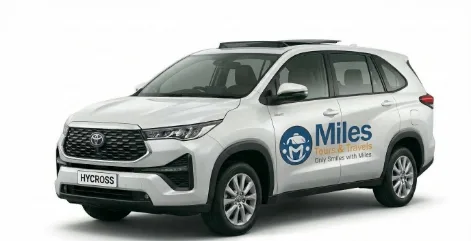
The Toyota Innova Hycross is Mumbai's most premium hybrid cab (6 traveller + 1 driver). Its near-silent petrol-hybrid engine, panoramic sunroof, and luxury cabin make it the first choice for international airport transfers, premium outstation trips, and corporate executive travel where your first impression matters.
- 6 traveller + 1 driver with captain seats
- Petrol-hybrid — silent, smooth, fuel-efficient
- Panoramic sunroof (GX variant)
- Dual-zone climate control
- Police-verified professional chauffeur
- No surge pricing — fixed, published rates
Innova Hycross Rental Rates in Mumbai (2026)
| Package Type | Rate / Price | Extra km | Extra Hour | Inclusions |
|---|---|---|---|---|
| Local – 4 Hrs / 40 Km | ₹3,000 | ₹28/km | ₹500/hr | Driver, fuel, AC |
| Local – 8 Hrs / 80 Km | ₹5,000 | ₹28/km | ₹500/hr | Driver, fuel, AC |
| Airport Transfer | ₹2,200 onwards | ₹28/km | — | Driver, fuel, meet & greet |
| Outstation – One Way | ₹28/km | Min 300 km/day | Driver, fuel, AC | |
| Outstation – Round Trip | ₹28/km | Min 250 km/day | Driver, fuel, AC | |
Toll, parking, state border permit charged at actuals. Driver allowance ₹500/day on overnight trips. No surge pricing and no hidden fees — early-morning pickups before 6 AM and late-night drops after 10 PM carry a small fixed extra charge.
Hycross vs Crysta vs Kia Carnival vs Ertiga — Full 10-Row Comparison
Most customers comparing hybrid MPVs are really weighing four cars: the petrol-hybrid Innova Hycross, the diesel Innova Crysta, the larger Kia Carnival (true luxury MPV territory), and the more compact Maruti Ertiga CNG (the budget pick). Each wins on something different. The table below is built from real fleet experience — fuel-efficiency numbers are our own averaged readings, not brochure claims, and per-km rates are our 2026 outstation tariffs.
The shortest summary: the Hycross is the best premium choice for mixed urban + short-outstation use because the hybrid system pays back its higher per-km rate in cabin comfort, silence, and fuel saved in traffic. The Crysta is unbeatable on highway economy for long outstation runs. The Carnival is in a different league for ultra-VIP guests and luggage-heavy international airport runs, but the rate reflects that. The Ertiga CNG is the smart pick for families who want 6 traveller + 1 driver seating without paying MPV-class rates. Use the table to match the car to the trip.
| Feature | Innova Hycross | Innova Crysta | Kia Carnival | Maruti Ertiga |
|---|---|---|---|---|
| Engine type | 2.0L Petrol-Hybrid (e-CVT) | 2.4L Diesel (manual/auto) | 2.2L Diesel (8-spd auto) | 1.5L Petrol / CNG |
| Mileage (city / highway) | 21–23 km/l city · 18–20 km/l highway | 12–14 km/l city · 14–16 km/l highway | 10–12 km/l city · 13–14 km/l highway | 18–20 km/l city · 20–22 km/l highway |
| Seating capacity | 7 (captain seats middle row) | 7 (bench or captain) | 7 (premium recliners) | 7 (3-row bench) |
| Boot space (3rd row up) | ~300 L (large) | ~300 L (large) | ~540 L (largest in class) | ~210 L (compact) |
| Sunroof | Yes — panoramic | No | No (sliding roof on top trim only) | No |
| Hybrid / EV mode | Series-parallel hybrid, EV-only under 40 kmph | No | No | No (mild-hybrid SHVS only) |
| Climate zones | Dual-zone auto + rear vents | Dual-zone auto + rear vents | Tri-zone auto | Single-zone manual + rear vents |
| Sound system | JBL 9-speaker premium | 6-speaker stock | Bose 12-speaker | 4-speaker stock |
| Per-km outstation rate | ₹28/km | ₹20/km | ₹75/km | ₹17/km |
| Best for | Premium airport, weddings, mixed city + short outstation | Long outstation, budget MPV travel | VIP transfers, large luggage, ultra-comfort | Family budget trips, group sightseeing |
Innova Hycross vs Innova Crysta — Which Should You Choose?
Both are 7-seater MPVs from Toyota, but they serve different travellers. The table below puts Hycross first because this is a premium hybrid cab page — but we also link to the Innova Crysta rental page so you can compare both and choose honestly.
| Feature | Innova Hycross | Innova Crysta |
|---|---|---|
| Engine | 2.0L Petrol + Electric Motor (Hybrid) | 2.4L Diesel |
| City fuel efficiency | 21–23 km/l (electric assist in traffic) | 12–14 km/l (diesel) |
| Cabin noise in traffic | Near-silent — electric mode below 40 km/h | Diesel clatter audible at idle |
| Panoramic sunroof | Yes — large glass panel, tilts + slides | No |
| Ventilated front seats | Yes (higher trims) | No |
| 2nd-row seating | Individual captain seats with armrests | Bench or captain (variant dependent) |
| AC during engine-off | Yes — electric compressor keeps blowing cold | No — warm air when engine cuts at signal |
| CO₂ emissions (city) | ~115–130 g/km | ~170–185 g/km |
| Outstation rate | ₹28/km one-way · ₹28/km round-trip | ₹20/km one-way · ₹20/km round-trip |
| Local 8-hr / 80-km package | ₹5,000 | ₹4,000 |
| Best for | Corporate, weddings, airport, premium city rides, short outstation | Budget outstation, long highway trips (300+ km) |
Innova Hycross for Mumbai Airport Transfers
The Innova Hycross is the top-rated luxury airport cab in Mumbai. Its large panoramic sunroof, whisper-quiet hybrid engine, and premium cabin set it apart from conventional taxis. We serve CSMIA T1 (domestic) and T2 (international) — covering pickups and drops from any address in Mumbai, Thane, Navi Mumbai, and Panvel.
Flight tracking is included: if your flight is delayed by up to 2 hours, your Hycross driver waits at no additional charge. Popular pickup zones: Andheri, Bandra, BKC, Worli, Powai, Juhu, Thane, Vashi, Kharghar, Panvel. Airport pickup starts at ₹2,200 within Mumbai — flat fare, no surge at midnight.
Innova Hycross for Mumbai Local Sightseeing
The 8-hour / 80-km local package (₹5,000) lets you explore Mumbai in style. The hybrid engine means fewer stops, no diesel noise, and a smooth, quiet ride through the city's crowded streets. A typical premium sightseeing day includes:
- Gateway of India & Taj Mahal Palace Hotel
- Marine Drive — Queen's Necklace promenade
- Siddhivinayak Temple — Prabhadevi
- Bandra-Worli Sea Link — iconic 8-lane bridge
- Haji Ali Dargah — island mosque, Worli
- Juhu Beach — sunset & street food
- Bandstand Promenade — Bandra seafront
- Dharavi — unique urban landmark
- CST (Heritage Station) — UNESCO World Heritage Site
- Colaba Causeway — shopping & cafes
Popular Outstation Routes — Innova Hycross from Mumbai
Popular Outstation Routes from Mumbai
Book Innova Hycross for comfortable outstation travel. Select a destination below for detailed route information, attractions, FAQs and live pricing.
Toyota Innova Hycross Cab Pickup — Mumbai Neighbourhood Guide
Whether you are booking from South Mumbai's colonial boulevards or Navi Mumbai's planned townships, the Toyota Innova Hycross by Miles Tours and Travels reaches you with its petrol-hybrid drivetrain already warmed up and ready. Each neighbourhood below lists key landmarks, indicative fares, and the specific hybrid advantage you will feel the moment the car glides into your lane.
Innova Hycross Cab in Andheri
Andheri is Mumbai's commercial engine, with pickup points spanning Andheri Station (East and West), D.N. Nagar, Versova, the MIDC industrial belt, and the Lokhandwala Complex. For travellers heading to Chhatrapati Shivaji Maharaj International Airport — just 8–12 minutes from Andheri East — the Hycross fare runs approximately ₹900–₹1,100 for a one-way airport transfer. For the Mumbai–Pune Expressway run, expect roughly ₹3,200–₹3,800 depending on the exact drop zone in Pune.
Hybrid advantage: Andheri's Western Express Highway service roads are notorious for bumper-to-bumper crawls during school and office hours. The Hycross switches to near-silent electric mode below 40 kmph, letting the engine cut out completely in heavy queues. Passengers report a noticeably cooler, quieter cabin compared with a conventional diesel cab — ideal when you need a relaxed start before a long trip.
Peak traffic tip: If departing for the airport between 8–10 AM or 5–8 PM, add 20 minutes buffer. Book your Hycross at least 60 minutes before your desired pickup time during these windows.
Innova Hycross Cab in Bandra
Bandra — Mumbai's social nucleus — offers pickups from Bandra Station (East/West), Carter Road, Linking Road, Mount Mary Church, Bandstand, and the Bandra-Worli Sea Link toll plaza. An airport transfer from Bandra to CSMIA costs approximately ₹1,100–₹1,350 one-way in the Hycross, reflecting the hybrid premium over the standard Crysta. For Pune, reckon on ₹3,400–₹4,000 one-way.
Hybrid advantage: The Bandra approach to the Sea Link involves frequent acceleration-and-braking as vehicles queue at the toll. The Hycross regenerative braking captures kinetic energy during each deceleration, converting it into battery charge rather than heat — so by the time you glide onto the Sea Link's open span, the hybrid battery is topped up and the engine runs in its most efficient band.
Peak traffic tip: Weekday evenings between 6–9 PM see the Hill Road–Linking Road corridor fully gridlocked. A Sea Link routing via Bandra East adds only 10 minutes but saves 25–35 minutes versus the Hill Road route to the airport.
Innova Hycross Cab in BKC (Bandra Kurla Complex)
BKC is Mumbai's premier financial district, home to the NSE, BSE, American Consulate, MMRDA grounds, and dozens of multinational headquarters. Common pickups include the G-Block and C-Block main roads, the MMRDA exhibition grounds gate, and the Trident hotel porch. Airport transfer from BKC in the Hycross runs ₹1,050–₹1,250; a Pune business trip costs around ₹3,300–₹3,900.
Hybrid advantage: BKC's internal roads are a textbook stop-go environment — signals every 150 metres, constant u-turns near the consulate queues, and construction diversions year-round. In this environment the Hycross switches to near-silent electric mode, making your ride noticeably quieter and dramatically more fuel-efficient than a diesel alternative. Business passengers taking calls or reviewing decks appreciate the reduced cabin vibration.
Peak traffic tip: The BKC connector to the Western Express Highway jams badly 7–9:30 AM. For airport departures, route via the Sion–BKC connector to the Eastern Express Highway — typically 15 minutes faster before 9 AM.
Innova Hycross Cab in Powai
Powai's tree-lined lakeside avenues, Hiranandani Gardens, IIT Bombay campus, Galleria Mall, and the Chandivali IT cluster all make it a busy cab origin. The Hycross airport run from Powai to CSMIA is short — typically 20–35 minutes — and costs approximately ₹900–₹1,100. For Pune outstation, most Powai guests pay ₹3,200–₹3,700 one-way.
Hybrid advantage: Powai's lakeside drives are gentle and scenic, but the Chandivali signal and the JVLR (Jogeshwari–Vikhroli Link Road) junction can turn ferocious during peak hours. The Hycross's electric-first launch — the engine stays off from standstill until battery depletes — means zero exhaust fumes near Powai Lake's promenade, a point appreciated by environmentally conscious IIT and tech-campus travellers.
Peak traffic tip: JVLR becomes severely congested 9–11 AM. For airport runs after that window, SCLR (Santacruz–Chembur Link Road) via the Eastern highway is the faster path.
Innova Hycross Cab in Juhu
Juhu — Mumbai's celebrity coastline — has pickups near Juhu Beach, JVPD Scheme, Vile Parle West station, the Ramada hotel strip, and the Film City access road at Goregaon. Because Juhu sits immediately west of the airport, Hycross transfers to CSMIA cost only ₹750–₹950, making it one of the most affordable airport zones in the city. Pune runs go for ₹3,100–₹3,600.
Hybrid advantage: Juhu's narrow lanes — especially inside JVPD colony — see the Hycross run almost entirely on electric power at low residential speeds, which means no diesel rattle past bungalow gates and a near-whisper approach to hotel porticos. This is especially valued by production crews and film industry guests transiting at odd hours.
Peak traffic tip: Airport-bound traffic on the Juhu–Vile Parle connector spikes 9–11 AM and 3–5 PM due to school runs. For daytime airport departures, the Juhu Tara Road–Santacruz approach via S.V. Road is often 10 minutes faster.
Innova Hycross Cab in Borivali
Borivali anchors Mumbai's far-north residential belt, with pickups from Borivali Station (East/West), Dahisar Toll Naka, Ekta Nagar, IC Colony, and the Sanjay Gandhi National Park gate on the eastern side. Airport fares from Borivali in the Hycross run approximately ₹1,400–₹1,700, and Pune outstation trips cost ₹3,600–₹4,200.
Hybrid advantage: The Western Express Highway from Dahisar to the airport — often 25–40 km of intermittent crawl — is where the Hycross's hybrid system pays its biggest dividend. At highway speeds the petrol engine takes over efficiently, but every brake-and-crawl phase recharges the battery. Passengers riding from Borivali consistently notice that the air-conditioning never falters even in full traffic-jam conditions, because the hybrid battery supports the compressor independently.
Peak traffic tip: Borivali is 32–40 km from CSMIA. Allow 70–90 minutes during weekday mornings. Early 5–6 AM departures clear the highway in under 45 minutes.
Innova Hycross Cab in Kandivali
Kandivali serves a dense mix of residential towers in Thakur Complex, Lokhandwala Township, and Charkop, plus the Growel's 101 Mall and Kandivali Station. Hycross airport transfers from here cost approximately ₹1,300–₹1,550; Pune trips run ₹3,500–₹4,000.
Hybrid advantage: Kandivali's internal roads around Thakur Complex are unusually wide but get clogged near the Akurli Road junction. The Hycross holds a real advantage in these medium-speed crawls (20–40 kmph) where the hybrid system splits power between engine and motor, delivering smooth, lag-free acceleration past roundabouts without the diesel torque surge that can unsettle luggage in the rear bay.
Peak traffic tip: The S.V. Road through Kandivali jams around school hours (7:30–9 AM, 2–4 PM). For airport pickups, request the Link Road–Western Express Highway merge point to bypass the S.V. Road bottleneck entirely.
Innova Hycross Cab in Malad
Malad hosts Infiniti Mall, Mindspace IT Park, Malad Station, Marve Beach, and the sprawling Orlem and Evershine Nagar localities. A Hycross airport transfer from Malad costs roughly ₹1,200–₹1,450, and Pune outstation sits at ₹3,400–₹3,900.
Hybrid advantage: Mindspace and the Malad–Andheri stretch of the Link Road are home to some of the densest IT commute traffic in the city. The Hycross's near-silent electric operation below 40 kmph makes a tangible difference during the final approach through office-campus slip roads, where conventional diesels idle loudly and emit visible fumes. Corporate travellers booking for early-morning Pune business trips from Malad frequently cite the calm cabin start as a deciding factor.
Peak traffic tip: Malad East's Dindoshi area near the court complex gets heavily congested Wednesday and Friday afternoons. Plan to exit via the Western Express Highway on-ramp at Malad rather than navigating through Goregaon East.
Innova Hycross Cab in Goregaon
Goregaon is home to Film City, the NESCO exhibition grounds, Oberoi Mall, and the rapidly expanding Aarey Colony transit hub. Key pickup points include Goregaon Station (East/West), the Film City main gate, and the NESCO IT Park approach road. Hycross airport transfers cost approximately ₹1,150–₹1,350; Pune runs are ₹3,300–₹3,800.
Hybrid advantage: Aarey Colony's internal roads — narrow, forested, with speed-breakers every 200 metres — see the Hycross running entirely on electric power most of the time, producing zero direct emissions inside a protected green zone. This resonates strongly with travellers conscious of Aarey's ecological sensitivity. The near-zero vibration also means a smoother ride over Aarey's many small potholes compared with a stiff diesel cab.
Peak traffic tip: Film City-related event days see the colony entrance road blocked for 20–40 minutes. Confirm pickup via the Goregaon flyover side if Film City is reporting a shoot day.
Innova Hycross Cab in Thane
Thane — Mumbai's satellite city — provides pickups from Thane Station, Viviana Mall, Hiranandani Estate, Ghodbunder Road, and the Eastern Express Highway on-ramp at Kapurbawdi. For the airport, a Hycross transfer runs ₹1,600–₹1,950 one-way. Pune outstation trips from Thane, which follow the Mumbai–Pune Expressway after Kalyan-Shil Road, typically cost ₹3,700–₹4,300.
Hybrid advantage: Ghodbunder Road — Thane's busiest arterial — is characterised by long platoon-style queues near the Majiwada junction and Brahmand complex. The Hycross's regenerative system harvests energy on every deceleration, which is unusually frequent on this road. By the time the cab reaches the Eastern Express Highway, the hybrid battery is well-charged, letting the engine operate in its sweet-spot efficiency band all the way to the airport.
Peak traffic tip: Thane–Airport via Eastern Express Highway is best between 10 AM–1 PM on weekdays. Morning rush (8–10 AM) adds 30–45 minutes; evening (5–8 PM) can add 50+ minutes.
Innova Hycross Cab in Navi Mumbai
Navi Mumbai's planned layout means well-spaced pickup points: Vashi Station, Belapur CBD, Nerul, Palm Beach Road, and the upcoming Navi Mumbai International Airport corridor. Hycross airport transfers (to existing CSMIA) from Navi Mumbai range from ₹1,700–₹2,200; Pune trips are often the most economical outstation from here at ₹2,500–₹3,000, since the Expressway entry at Kharghar is just minutes away.
Hybrid advantage: Palm Beach Road — Navi Mumbai's scenic coastal expressway — offers 60–80 kmph stretches where the Hycross runs on its petrol engine at peak thermal efficiency. However, the Vashi Bridge toll and Sion–Panvel highway junction return to stop-go mode, where the electric system seamlessly takes over. Passengers enjoy a completely uninterrupted driving experience with no gear-change jolt.
Peak traffic tip: The Airoli Bridge sees extreme congestion 8:30–10:30 AM. For airport runs from Navi Mumbai, the Vashi–Sion route via the Eastern Freeway is consistently 20 minutes faster than crossing Airoli.
Innova Hycross Cab in Panvel
Panvel sits at the gateway to the Konkan and is a natural departure hub for Goa, Pune, and Nashik trips. Pickup points include Panvel Station (Old and New), the Mumbai–Pune Expressway toll, Kamothe, and the proposed Navi Mumbai Airport precinct. A Hycross airport transfer to CSMIA costs approximately ₹1,900–₹2,400; Pune runs start as low as ₹2,200–₹2,700 given the proximity to the Expressway entry.
Hybrid advantage: The NH66 Goa highway starts at Panvel and immediately climbs into the Sahyadri foothills. On the uphill gradients near Khopoli, the Hycross intelligently combines petrol engine output with electric motor torque — delivering better hill-climbing pull with less engine strain than a standalone petrol Crysta of the same capacity. Passengers notice the engine never sounds stressed on ascents.
Peak traffic tip: Panvel junction's Kalamboli intersection is a notorious choke-point on Friday evenings as Goa-bound vehicles and local traffic merge. Depart before 3 PM or after 9 PM on Fridays to avoid 45–60 minute delays at this single junction.
Innova Hycross Cab in Kharghar
Kharghar is Navi Mumbai's most scenic node — home to the Central Park, Kharghar Hills, ISBE campus, and a grid of well-maintained sector roads. Pickup points include Kharghar Station, Sector 10 and 35 main roads, and the Central Park lawn entrance. Hycross airport transfers run approximately ₹1,800–₹2,200; for Pune, proximity to the Expressway brings the fare down to ₹2,300–₹2,800.
Hybrid advantage: Kharghar's hills create natural downhill segments within the colony. The Hycross's regenerative braking is particularly effective here — every downhill approach to a sector signal tops up the battery without the driver touching the brake aggressively. Long-distance travellers departing for Pune or Mahabaleshwar from Kharghar benefit from a fuller battery pack entering the Expressway, which means more frequent electric-assist during Pune city drop-off traffic.
Peak traffic tip: Kharghar–Panvel connector road sees school rush at 7–9 AM. For airport trips, leave before 7 AM or after 9:30 AM to clear the connector quickly.
Innova Hycross Cab in Dadar
Dadar — Mumbai's true geographic and cultural heart — offers pickups from Dadar Station (East/West), Shivaji Park, Ruia College, Five Gardens, and the Dadar flower market area. A Hycross airport transfer from Dadar costs approximately ₹1,300–₹1,550; Pune runs are ₹3,300–₹3,800.
Hybrid advantage: Dadar's road grid is a textbook of Mumbai's worst bottlenecks: the Dadar TT circle, the Gokhale Road–Western Express Highway merge, and the Tilak Bridge rail crossing. In these conditions the Hycross spends long minutes in full electric mode, giving passengers in the rear the unusual luxury of a near-silent, vibration-free cab wait with climate control running — something no diesel can match.
Peak traffic tip: The Dadar TT circle is at its worst 9–11 AM and 6–8 PM. For airport trips, a 5 AM or 11 AM departure cuts travel time to CSMIA from 50 minutes to a reliable 30 minutes.
Innova Hycross Cab in Kurla
Kurla is one of Mumbai's busiest transit nodes, with the LBS Marg as its commercial spine, Phoenix Marketcity Mall, Kurla Station (East/West), and the SCLR interchange giving fast access to the airport. Hycross airport transfers from Kurla cost approximately ₹1,050–₹1,250; Pune outstation runs around ₹3,200–₹3,700.
Hybrid advantage: The LBS Marg in Kurla runs at less than 20 kmph during peak hours, putting the Hycross into sustained electric-only operation. For a cab picking up from Phoenix Mall or Kurla Station, this means zero engine noise while loading luggage at the kerb — a subtle but real comfort difference in a neighbourhood known for ambient noise. Eco-conscious travellers also appreciate that the cab arrives without diesel idling fumes.
Peak traffic tip: Kurla's Nehru Nagar flyover approaches see the sharpest congestion on weekday evenings. Request your Hycross pickup from the Phoenix Marketcity side exit rather than the main LBS Marg gate to shave 10–15 minutes.
Innova Hycross Cab in Ghatkopar
Ghatkopar anchors the eastern suburbs' retail and residential corridor, with pickups from Ghatkopar Station, R-City Mall, Vikrant Circle, and the Eastern Express Highway slip roads. A Hycross airport transfer runs approximately ₹1,100–₹1,350; Pune trips cost ₹3,200–₹3,700.
Hybrid advantage: The Eastern Express Highway from Ghatkopar to the Sion flyover is a long, irregular crawl with bursts of 60–80 kmph on elevated sections and near-standstill under the Chunabhatti flyover. This variable-speed pattern is exactly where the Hycross's series-parallel hybrid excels — the system continuously shifts between motor, engine, and combined modes with no driver input, always selecting the most fuel-efficient path. Families booking for early Pune trips from Ghatkopar appreciate that the cabin remains cool and quiet throughout.
Peak traffic tip: Eastern Express Highway at Ghatkopar is clear by 6:30 AM but jammed by 8 AM. For CSMIA departures, an early-morning Hycross pickup virtually guarantees a 20-minute airport run.
Innova Hycross Cab in Mulund
Mulund sits at Mumbai's north-eastern tip bordering Thane, with Mulund Station, LBS Road, the Check Naka (Mumbai–Thane boundary), and the Eastern Express Highway on-ramp as key pickup reference points. A Hycross airport transfer from Mulund costs approximately ₹1,400–₹1,700; Pune outstation, which typically routes via the Thane–Belapur Road or through Airoli, runs ₹3,500–₹4,000.
Hybrid advantage: The Mulund Check Naka toll area — technically the LBS Marg junction — sees the Hycross waiting in electric mode for extended periods at the octroi (now toll) inspection points. Unlike a diesel idling in the queue, the hybrid system shuts the engine entirely and maintains cabin temperature via the battery, so passengers are spared the fume cloud that conventional vehicles generate in this enclosed underpass area.
Peak traffic tip: Cross the Check Naka before 8 AM or after 9:30 AM on weekdays. The post-9:30 AM window is the most reliable for a smooth Eastern Freeway run to the airport.
Innova Hycross Cab in Vikhroli
Vikhroli is defined by the Godrej campus — one of India's largest integrated urban estates — as well as the Pirojshanagar township, JVLR junction, and Vikhroli Station. Hycross airport transfers from Vikhroli cost approximately ₹1,100–₹1,300, and Pune outstation trips run ₹3,100–₹3,600.
Hybrid advantage: The Godrej campus is a rare piece of Mumbai's forest-adjacent green belt; the Mangrove Creek runs alongside parts of the estate. The Hycross's electric-only operation at low speed means no exhaust emissions inside this eco-sensitive corridor — an alignment with Godrej's own sustainability values that corporate guests from the campus tend to notice and appreciate. Miles Tours and Travels drivers are instructed to maintain electric-priority mode through the entire campus approach.
Peak traffic tip: JVLR connecting Vikhroli to the Western suburbs is gridlocked 8:30–10 AM. For airport runs, the SCLR–Eastern Freeway combination avoids JVLR entirely and is consistently 20 minutes faster.
Innova Hycross Cab in Worli
Worli sits between South Mumbai's heritage district and the Bandra-Worli Sea Link's northern anchor — giving it unbeatable connectivity. Pickup points include Worli Sea Face, Atria Mall, the Nehru Planetarium, NCP headquarters road, and the Haji Ali junction. Hycross airport transfers from Worli cost approximately ₹1,250–₹1,500; Pune outstation is ₹3,400–₹3,900.
Hybrid advantage: The Sea Link crossing from Worli to Bandra — 5.6 km of open cable-stayed bridge — is the one stretch in Mumbai where traffic moves at a sustained 60–80 kmph with minimal braking. On this section the Hycross petrol engine operates in its most thermally efficient range. Paired with the pre-charged battery from the Worli approach stop-go, the cab achieves its best combined fuel economy of the entire journey on this single stretch — a small but satisfying demonstration of hybrid engineering.
Peak traffic tip: Sea Link toll plaza backs up 6–9 PM on weekdays and Sunday evenings. For Worli–airport runs post 6 PM, the Sion–Matunga Eastern route avoids the Sea Link queue and is comparable in time.
Innova Hycross Cab in Colaba
Colaba — Mumbai's southernmost tip and historic centrepiece — draws pickup requests from the Gateway of India, the Taj Mahal Palace Hotel, Colaba Causeway, the Regal Cinema junction, and the Afghan Church. Being farthest from the airport, a Hycross transfer from Colaba to CSMIA costs approximately ₹1,600–₹2,000; for Pune, the fare runs ₹3,600–₹4,200 given the long city traverse first.
Hybrid advantage: The 22–28 km drive from Colaba to CSMIA traverses some of Mumbai's most congested corridors — Marine Drive, Haji Ali, Worli, Sea Link, Bandra — and almost every segment involves stop-go running. This is the single booking origin where the Hycross's hybrid advantage is most measurable: the entire city portion runs predominantly in electric mode, and the battery regenerates on every braking event, delivering a fuel-efficiency profile that no conventional cab can match over the same distance.
Peak traffic tip: Colaba to airport takes 75–120 minutes on weekday mornings. A 4:30–5:30 AM departure clears the entire city in under 55 minutes. Miles Tours and Travels recommends booking your Hycross the evening before for any Colaba early-morning flight.
How the Toyota Innova Hycross Hybrid System Works — A Plain-English Explanation
You do not need to be an engineer to appreciate what makes the Hycross feel different from every other cab you have ever ridden in. Here is the full picture, in everyday language.
The Series-Parallel Architecture
The Toyota Innova Hycross uses what engineers call a series-parallel hybrid system — the same fundamental architecture used in the Toyota Prius and Camry Hybrid. In practice, this means the car has two separate power sources: a 2.0-litre naturally aspirated petrol engine and an electric motor driven by a nickel-metal hydride battery pack mounted below the floor. Crucially, the car can run on either source independently or on both simultaneously, and the onboard computer makes this switching decision hundreds of times per minute with no input from the driver and no gear-change sensation for passengers.
At speeds below roughly 40 kmph — the exact threshold that covers most of Mumbai's peak-hour crawl — the Hycross frequently runs in electric-only mode. The petrol engine shuts off completely. The cabin becomes extraordinarily quiet: no vibration through the seat, no exhaust note, no diesel rattle. Passengers who ride the Hycross for the first time in a Mumbai traffic jam often ask whether the car has stalled. It has not — it is simply running on clean, silent electricity.
Real Fuel Economy: Hycross vs Crysta
City fuel consumption for the Toyota Innova Crysta (diesel) typically runs 9–11 kmpl in real-world Mumbai stop-go traffic. The Hycross, with its electric assist during exactly the same low-speed conditions, achieves 14–16 kmpl in the city — a 40–60% improvement. On the open Mumbai–Pune Expressway the gap narrows (both perform better at highway speeds), but the aggregate saving across a mixed airport-or-Pune trip still sits at 20–30% in the Hycross's favour.
In terms of CO₂ emissions, the Crysta diesel produces approximately 170–185 g/km in urban conditions. The Hycross's petrol-electric combination drops this to roughly 115–130 g/km — around 30% lower. For travellers who need to report or offset their corporate carbon footprint, the Hycross is the verifiably lower-emission cab choice currently operating in Mumbai.
What You Experience in the Cabin
In slow Mumbai traffic, passengers in the Hycross notice three things immediately: the absence of vibration through the seat cushion, the absence of engine sound during stopped phases, and the fact that the air-conditioning continues to blow cold even when the petrol engine is off. This last point matters on a Mumbai summer afternoon — the hybrid battery powers the compressor independently, so you are never waiting for the engine to restart before the cabin cools again.
Outstation Economics: Does the Higher Rate Make Sense?
The Hycross is priced at ₹28/km one-way and ₹28/km round-trip — a small premium over the Crysta. On a 300 km Pune round trip, the Hycross costs approximately ₹1,560 more in cab fare than the Crysta. However, if your party shares the cab, the per-head premium drops to ₹220–₹310 per person for 5–7 passengers — in exchange for a quieter, smoother, lower-emission ride with more legroom in the second row and a panoramic sunroof that no Crysta offers. For most outstation travellers, the trade-off is immediately worthwhile.
Regenerative Braking on Mumbai's Elevated Structures
The Bandra-Worli Sea Link and the Eastern Freeway both involve brief deceleration phases at toll plazas and merge points. Every time the Hycross decelerates on these structures, the electric motor runs in reverse as a generator — converting the car's momentum back into electricity stored in the battery. On the Sea Link approach, a single braking event from 80 to 0 kmph at the toll can recover enough energy to power electric-only driving for the next 2–4 km of slow city road beyond the toll gate. This seamless energy cycling is what gives the Hycross its uniquely consistent fuel economy across Mumbai's wildly variable traffic conditions.
The Innova Hycross Panoramic Sunroof — A Route-by-Route Experience Guide
The Toyota Innova Hycross's panoramic sunroof spans nearly the full length of the cabin roof — a glass panel that transforms an outstation journey from a transport event into a scenic experience. But the sunroof earns its reputation on specific routes, at specific times, in specific weather. Here is exactly where and when to open it.
Alibaug — The Revdanda Beach Coastal Stretch
After leaving the Mandwa ferry landing and driving south on the coastal road toward Revdanda Beach, the road opens onto a flat tidal plain with the Arabian Sea visible to the west. Slide the Hycross sunroof fully open here (October to February). The salty breeze and the wide-open sky above the paddy fields make this one of the most atmospheric sunroof moments within two hours of Mumbai. The low-speed coastal road means wind noise stays manageable even at full aperture.
Bhor Ghat — After Khopoli, Before Khandala
The Mumbai–Pune Expressway climbs the Western Ghats between Khopoli and Khandala through a series of sweeping curves surrounded by monsoon-fed green escarpments (June–September) or rust-and-amber hillsides (November–February). Open the Hycross sunroof at the Khopoli toll and keep it open until the Khandala plateau. At 60–80 kmph the airflow is invigorating rather than overwhelming — the panoramic glass frame channels wind efficiently overhead. The valley views on the left side descending toward Pune are best appreciated through the glass when the sunroof is tilted rather than fully slid.
Tamhini Ghat — Golden Hour to Mahabaleshwar
The Tamhini Ghat road running from Mulshi toward Mahabaleshwar is one of Maharashtra's most celebrated forest drives — narrow, forested, with the canopy almost closing overhead in places. Open the Hycross sunroof after the Mulshi reservoir and keep it open through the forest plateau. On evenings between October and May, the low western sun filters horizontally through the trees and strikes the open glass panel in long amber shafts. Passengers in the second row get a front-row seat to a light show that no closed-roof cab can replicate.
Sea Link to Marine Drive — Mumbai at Night
This is the quintessential urban sunroof experience. Open the Hycross roof at the Bandra Sea Link toll and leave it open through the entire 5.6 km cable-stayed crossing. The Mumbai skyline rises to the north and east; the Arabian Sea stretches to the west; the cable towers are illuminated after sunset. Continue with the sunroof open along Marine Drive's Queen's Necklace stretch — the arc of streetlights curves below the glass panel in a perfect crescent. Best on clear October–February evenings after 8 PM when humidity drops and the sea breeze is cool but not cold.
Sawantwadi to Goa — NH66 Coastal Highway (Oct–Feb)
The NH66 coastal highway between Sawantwadi and the Goa border runs through a corridor of casuarina trees, tidal creeks, and beachside fishing villages. Between October and February, this is sunroof-open territory for the entire 60 km stretch — the air is dry, the road is quiet compared with peak-season, and the afternoon light on the palm-lined villages is spectacular. The Hycross's panoramic glass gives the full-width sky view that a standard cab sunroof simply cannot match.
Venna Lake — Mahabaleshwar Forest Roads
Mahabaleshwar's strawberry-farm lanes and the Venna Lake forest road have a canopy height low enough that the sunroof frames individual tree crowns as the cab passes underneath — an intimate, close-up view of the hill-station ecosystem. Open the roof on the approach from the old Mahabaleshwar road and keep it open around the lake perimeter. The breeze here carries the distinct cedar-and-strawberry scent of the plateau at 1,372 metres — something no air-freshener inside a closed cab can substitute.
When NOT to Open the Sunroof
Mumbai monsoon (June–August): Rainfall arrives suddenly and sideways on the Expressway. Even a brief open-roof moment can drench the second-row passengers and the headlining fabric in seconds. Keep the sunroof firmly closed June through August across all routes.
Dusty highway nights: The NH48 (Mumbai–Pune Expressway) after midnight, and any NH66 stretch through active construction zones, carry airborne laterite dust that coats the cabin, seats, and passengers instantly if the roof is open. At night, ambient light makes dust invisible until it has already settled on every surface.
The sunshade compromise: If you want breeze without full sun or rain exposure, slide the Hycross's integrated fabric sunshade halfway across. This blocks direct sunlight and light drizzle while still allowing airflow through the tilted glass panel — a particularly useful configuration on early-morning Expressway runs when the sun is low and directly ahead but the air temperature is still pleasant.
Monsoon Travel Guide — The Hycross in Mumbai Rain
Monsoon is the season the Hycross was almost designed for. The hybrid powertrain produces full motor torque from zero rpm, so pulling out of a flooded junction is smoother and more controlled than a diesel that has to spool up. Regenerative braking is the quiet hero in rain — because most everyday braking is done by the electric motor rather than friction pads, the wheels are slowed more progressively, which dramatically reduces the chance of skidding on a wet road. Anti-lock brakes still kick in if needed, but the motor's "engine braking on demand" effect keeps weight evenly distributed.
Routes that work well — and the ones that don't
Good in monsoon: Mumbai–Lonavala–Khandala (the Expressway drains well), Mumbai–Mahabaleshwar via Mahad (wide road, fewer landslip points), Mumbai–Nashik through Kasara (treated tarmac on the climb). Avoid in active monsoon: Tamhini Ghat (frequent rockfall, narrow with no shoulder), the old Mumbai–Goa NH66 in heavy rain stretches around Chiplun (chronic flooding), and the unpaved approach roads to many Konkan beach resorts. Our control room watches IMD bulletins and will proactively re-route you.
Monsoon kit we carry in every Hycross
Each vehicle is stocked from June to September with: two large umbrellas, microfibre towels, plastic floor-mat covers, a torch, a basic first-aid kit, and disposable shoe-covers for muddy pickups. Drivers carry a tyre puncture kit. Sunroof stays closed by default in rain — we will not open it above 40 kmph regardless of the request. AC defogger is set on auto before pickup.
Pilgrimage Travel Guide — Shirdi, Tirupati & Pandharpur in a Hycross
Pilgrimages are the use-case where the Hycross most quietly outshines the Crysta. Many of our pilgrimage bookings are made by adult children for their parents, and the priority is unambiguous — elder comfort over fuel economy. The Hycross delivers that on three specific counts: ventilated front captain seats (a serious blessing on a Maharashtra summer afternoon), a near-silent cabin that lets seniors sleep through long stretches, and a step-in height low enough that boarding does not require gymnastics.
The three big-three routes
- Shirdi — 240 km, ~5 hours. Aim to leave Mumbai by 4 AM for the early-morning Kakad Aarti at 4:30 AM the next day if booking VIP darshan; otherwise an 8 AM departure puts you at the temple for the noon Madhyan Aarti. We pre-book paid darshan tickets on request.
- Tirupati — 1,300 km, 2–3 day trip. We recommend a Hycross with overnight halts at Pune and Tirupati rather than a single-shot drive. The hybrid's fuel-efficiency makes the long highway segments materially cheaper than they look on the per-km card. Sarva Darshan timings vary daily — confirm 48 hours before departure.
- Pandharpur — 380 km via Pune and Solapur. Best done as a 2-day round trip; the Vitthal Rukmini temple is busiest during Ashadhi Ekadashi but easier on regular weekdays. Mahapooja begins around 4 AM, Pahatecha Abhishek at 6 AM.
Drivers on pilgrimage routes are briefed on temple etiquette, footwear storage, and prasad handling. We carry small jute bags in the boot for offerings.
Corporate Travel Guide — Hycross for Premium Client Pickups
The Hycross has become the default "first impression" car for several MNC offices in BKC, Worli, and Powai. There are three reasons it consistently outperforms its peers for corporate use: the cabin is quiet enough to hold a sensitive client call between airport and office, the panoramic sunroof is a conversation starter on a Friday-evening drop, and the proper tax invoice we issue cleanly captures the tax number for input credit.
What Miles Tours and Travels offers corporate accounts
- Premium airport pickups — meet-and-greet at CSMIA T2 international arrivals with a name placard, bottled water, phone charger, and Wi-Fi hotspot on request.
- Monthly billing account — single consolidated invoice on the 1st of each month, line-itemed by employee, project code, or cost centre, with the company's tax number captured.
- Proper tax invoice for every trip — emailed within 2 hours of trip completion for business billing and input-credit claims.
- BKC SLA — guaranteed 12-minute spot for BKC pickups during peak hours (9–11 AM, 5–8 PM), backed by dedicated standby cars in the precinct.
- Dedicated relationship manager on WhatsApp for travel desks; escalation to the founder for any service issue.
Reach out to enquiry@milestoursandtravels.co.in for a corporate rate card and a sample tax invoice.
Wedding Hire Guide — The Hycross as Bride/Groom Car
The Innova Hycross has overtaken the Mercedes E-Class as Mumbai's most-booked premium wedding car in our fleet. The reason is practical, not aspirational — at Indian weddings, the bride or groom's car carries family alongside them, and a sedan simply doesn't have the space. The Hycross gives you seven seats, a luxurious second row with captain chairs the bride can settle into without crushing her outfit, and the sunroof that has become an unofficial requirement for the baraat entrance shot.
Ceremony & bride-car configurations
- Bride entrance — Hycross arrives with sunroof partly open, bride steps out under a portable canopy. The white or silver exterior photographs cleanly against any mandap backdrop.
- Groom's baraat car — sunroof fully open while the procession moves at walking pace, dhol-tasha visible behind, groom standing through the roof only when the vehicle is stationary (we are firm on this — moving baraat = roof closed for safety).
- Wedding fleet — multiple Hycross units for the immediate family, with junior cars (Crysta, Ertiga) for extended guests.
Decoration policy
We allow fresh-flower garlands, ribbons, and magnetic "Just Married" plaques. We do not permit adhesive tape, nails, or anything that damages the paint or trim. Our crew can arrange the decoration through a partner florist; floral packages start at ₹3,500. Vehicle is washed, polished, and interior-detailed the morning of the event. Call +91 88790 99744 to lock dates — wedding-season weekends sell out 6–8 weeks in advance.
Monsoon Travel Guide: Mumbai in an Innova Hycross (June–September)
Monsoon transforms Maharashtra's ghats into something spectacular — but only if you pick your routes wisely and your cab even more so. Miles Tours and Travels runs Innova Hycross bookings through the rains every year, and this guide distills what we've learned into practical advice.
Best monsoon routes from Mumbai:
- Lonavala (83 km): Bhushi Dam overflow, Tiger's Leap, and Rajmachi mist — peak spectacle July–August. Roads are NH48, wide and manageable.
- Kolad (117 km): White-water rafting on the Kundalika river runs June through September. The SH92 stretch past Khopoli stays largely clear.
- Bhandardara (185 km): Arthur Lake and Randha Falls reach peak volume in August. Take the Nashik Highway and turn at Sangamner — roads are reasonable outside landslide windows.
- Tamhini Ghat (95 km): The most photogenic ghat in the Sahyadris during monsoon. Dozens of temporary waterfalls appear along the 26-km ghat section. Go weekdays — weekend traffic backs up badly.
- Malshej Ghat (130 km) — with caution: Flamingos, mist, and dramatic views, but rock-fall warnings apply in heavy rain weeks. Check Maharashtra PWD alerts before booking.
Routes to avoid in peak monsoon: Mahabaleshwar sees regular road closures from July to mid-August — the Panchgani Ghat and Venna Lake approach flood at sustained rainfall. Coastal stretches near Murud-Janjira and Shrivardhan are prone to sea spray flooding on approach roads; avoid these in high-tide months.
Why the Innova Hycross is the right vehicle: Its 185mm ground clearance handles submerged sections that sedans cannot. The series-parallel hybrid system delivers full electric motor torque from zero rpm — pulling out of flooded junctions is smoother and more controlled than a diesel that has to spool up. Wide 225/55 R18 tyres maintain grip on wet ghat switchbacks, and the elevated seating position gives the driver sightlines over road-surface water accumulation that smaller cars simply can't match.
Must-carry kit: Carry waterproof ponchos or raincoats for every passenger, dry bags for electronics, a charged power bank (signals drop in ghats), a basic first-aid kit, and a printed paper map as backup — Jio and Airtel coverage is patchy above 600m.
Departure tip: Leave Mumbai before 6:00 am. Landslide-prone ghat sections are most dangerous between 10am and 2pm when overnight rainfall has saturated slopes. An early start gets you through the ghats and into your destination before the high-risk window opens.
Winter Getaway Guide: Best Routes from Mumbai (November–February)
Winter is when Maharashtra's hill stations earn their reputation. Temperatures drop, crowds are manageable until Christmas, and the roads — finally dry — are a pleasure to drive. Miles Tours and Travels sees its highest repeat-booking rate for leisure travel in this window, and for good reason.
Top winter routes from Mumbai:
- Mahabaleshwar (265 km): Strawberry season runs December through February. Visit Mapro Garden, Wilson Point for sunrise, and Venna Lake before the March tourist surge arrives. The Panchgani stretch is clear and smooth in winter — completely different from its monsoon self.
- Matheran (83 km): Morning mist rolls through the red-laterite pathways from November onwards. Since vehicles aren't allowed inside Matheran, your Innova Hycross drops you at the Dasturi parking point — hire a hand-cart or walk from there. Arrive by 7am to catch the mist at its thickest.
- Igatpuri (130 km): Home to Vipassana meditation centres with 10-day courses running year-round and shorter day-visit options. The drive up NH3 is fast; the return through Kasara Ghat is scenic in winter light.
- Bhimashankar (200 km): One of Maharashtra's 12 Jyotirlingas. Winter mornings here bring fog so dense the forest trail to the temple disappears 10 metres ahead — genuinely atmospheric. The ghat road after Khed is steep; the Hycross's electric motor torque handles the climb smoothly.
Fog driving tips for ghat roads: Switch to low beam headlights — high beam reflects off fog and blinds you faster. Reduce speed to under 30 km/h on ghat hairpins. If visibility drops below 20 metres, pull over at a lay-by and wait. Never overtake on a fog-covered bend.
Best departure time in winter: Unlike monsoon, delay your departure to post-9am in winter. Ghat fog typically lifts between 8:30am and 9:30am; driving through it in darkness or low light is the biggest risk. A 9am departure from Mumbai gets you to Mahabaleshwar by lunchtime comfortably.
Innova Hycross advantage in fog: The elevated seating position — driver's eye level sits roughly 30cm higher than a sedan — allows the driver to see over low-lying ground fog that forms in valley pockets. Combined with the wide windscreen and standard front fog lamps, winter ghat visibility is meaningfully better than in a compact car.
Pilgrimage Guide: Temple Routes from Mumbai in an Innova Hycross
Pilgrimage travel has its own rhythm — long queues, uncertain darshan timings, overnight stays, and the need to carry prasad, extra clothing, and sometimes elderly family members who need comfort for every kilometre. The Innova Hycross handles all of this better than any other vehicle in its class. Miles Tours and Travels operates dedicated pilgrimage routes throughout the year; here is what you need to know for each major destination.
Shirdi (240 km via Nashik): Take NH160 through Nashik — it's faster and better surfaced than the Pune bypass route. Avoid Friday departures; Shirdi draws its largest crowds on Fridays and the parking queues alone can add two hours. For darshan strategy, arrive before 5:00am for the Kakad Aarti (morning prayer) — the queue is shortest then and the atmosphere is most devotional. If you plan an overnight stay, book accommodation on the Rahata side rather than adjacent to the temple — it's quieter and 20% cheaper.
Tirupati (1,400 km — 2-day itinerary): Day 1 — depart Mumbai at 4am, drive via Pune–Solapur–Kurnool, arrive Tirupati by 8–9pm. Day 2 — complete darshan (book TTD online slot in advance; walk-in queues are 8–12 hours), then drive to Bengaluru (3.5 hours) or Hyderabad (3 hours) for the overnight return flight, or continue home on Day 3. The Innova Hycross's premium cabin and long-distance refinement make this gruelling journey as comfortable as possible. Petrol fuel is available at Kurnool and Kadapa — no range anxiety for the hybrid.
Pandharpur (390 km via Solapur Highway): The Ashadhi Ekadashi in 2026 falls on 7 July and Kartiki Ekadashi on 1 November — both attract 5–8 lakh pilgrims. If travelling on these dates, park at the Pandharpur bus stand outer lot (2km from temple) and walk — the inner approach roads are closed to vehicles. For off-peak visits, parking is available near the Chandrabhaga river ghat.
Trimbakeshwar (175 km): This is a comfortable day-trip. Depart Mumbai by 6:00am, reach Trimbakeshwar by 9:30am. Allow 3–4 hours for darshan (queues move slowly; the inner sanctum has restricted entry by dress code — traditional attire recommended). You can comfortably be back in Mumbai by 7pm. Note that the ghat road from Nashik to Trimbakeshwar is narrow — the Innova Hycross fits, but two large vehicles passing each other requires care.
Why the Innova Hycross for pilgrimage: The second-row captain seats allow elderly passengers to board without climbing over others. The hybrid system runs silently through the night on long overnight stretches, letting passengers sleep without diesel engine noise. And after six hours in a darshan queue, the cushioned seating and smooth ride home matter more than you'd think.
Corporate Travel Guide: Innova Hycross for Business Use in Mumbai
Corporate ground transport has two failure modes: the car that doesn't arrive, and the car that arrives but embarrasses you in front of a client. Miles Tours and Travels has structured its Innova Hycross corporate service to eliminate both. Here is how the service works for business accounts.
BKC-to-airport SLA: The BKC-to-Terminal-2 run is 14 km on a clear day and can stretch to 50 minutes in peak-hour traffic. Miles Tours and Travels guarantees a 45-minute transfer during business hours (8am–8pm) using a pre-planned buffer departure based on live traffic data. For early-morning and late-night flights — the windows where traffic drops — the same transfer typically completes in 22–28 minutes.
Monthly corporate accounts: Companies with regular ground transport needs can set up a monthly account with Miles Tours and Travels. The process involves a single email to our operations team with your registered company name, billing address, and expected monthly trip volume. We issue a consolidated invoice at month-end covering all trips, cross-referenced by employee name and trip purpose for your finance team's reconciliation. Minimum commitment: 8 trips per month.
Proper invoice for every booking: Every Innova Hycross trip — whether a single airport drop or a multi-day conference shuttle — includes a proper invoice with the trip date, route, vehicle number, and total fare. Our finance team turns invoices around within 24 hours of trip completion. Corporate clients on monthly accounts receive a single consolidated invoice on the 1st of the following month.
Driver briefing protocol: Corporate drivers are briefed separately from leisure drivers. Confidentiality of conversations is standard — drivers do not engage in discussion of routes, fares, or business overhead. Professional attire (collared shirt, dark trousers) is mandatory. Mobile phones are on silent and stowed during driving; music is off unless the passenger requests it.
Fleet availability for events: For conferences, product roadshows, and multi-vehicle client pickups, Miles Tours and Travels can deploy multiple Innova Hycross vehicles in coordinated convoy. Typical lead time is 48 hours for fleets of up to four vehicles; 5 days for larger requirements. A dedicated operations contact is assigned for the duration of the event to handle real-time changes.
Wedding Car Hire Guide: Booking Innova Hycross Vehicles for Your Big Day
Wedding logistics are unforgiving — a car that's ten minutes late or a convoy that gets separated on the way to the venue creates stress that no one at a wedding needs. Miles Tours and Travels has handled wedding fleets across Mumbai, Pune, and outstation venues; here is the complete guide to doing it right.
How many Innova Hycross vehicles do you need? Plan for 6 passengers per car in comfort — that allows luggage in the boot and breathing room in the cabin. A rough guide:
- 12 guests → 2 Innova Hycross
- 18 guests → 3 Innova Hycross
- 30 guests → 5 Innova Hycross
- 60 guests → 10 Innova Hycross (confirm fleet availability 30 days ahead)
If guests are travelling with heavy trolley bags or gift boxes, reduce to 5 passengers per car and add one extra vehicle to the count.
Decoration options: Miles Tours and Travels vehicles can accept floral garland decoration on the bonnet and door handles, ribbon bow on the roof antenna, and "Just Married" signage on the rear windscreen. These decorations are arranged and fitted by the renter's florist or decorator — we provide a clean vehicle and the driver will wait while decorations are applied (up to 30 minutes included at no charge).
Convoy coordination: For multi-car wedding convoys, Miles Tours and Travels conducts a lead-car briefing before departure: route, waypoints, pace, and emergency contacts. All drivers are added to a shared WhatsApp group with the event coordinator so real-time re-routing is instant. The lead car carries the wedding planner's direct number; every following driver has the lead car driver's number.
Honeymoon airport drop — early morning protocol: Early morning flights (3am, 4am, 5am) are common for honeymoon departures. Miles Tours and Travels handles these 3am pickups smoothly — the early-morning pickup charge (before 6 AM) is small, fixed, and confirmed upfront with your wedding fleet package. The driver arrives 10 minutes early, helps load luggage, and confirms terminal and airline before departure.
Pre-booking lead time: Book your wedding fleet a minimum of 7 days in advance for off-peak months (March–October). For peak wedding season — November through February — a 30-day minimum lead time is strongly recommended. Premium dates (Diwali week, Christmas, New Year's Eve) book out faster; confirm as soon as your venue date is fixed. Contact Miles Tours and Travels directly to lock your fleet — wedding bookings are not processed through the standard online booking flow.
Why Book Innova Hycross from Miles Tours and Travels?
Petrol-electric hybrid means near-silent city drives, lower carbon footprint, and better fuel efficiency in Mumbai traffic.
Large glass roof floods the cabin with natural light — perfect for weddings, photo shoots, and scenic outstation drives.
All drivers are police-verified, licensed, and trained. Driver ID shared before every trip. Zero-tolerance for rash driving.
No surge pricing, no app multipliers — fixed published rates. The price you see is what you pay; toll, parking, and any early-morning/late-night charge are itemised upfront.
We track your flight and adjust pickup time automatically. No extra charge for delays up to 2 hours.
Proper tax invoices issued for all corporate bookings. Monthly billing available for corporate accounts.
Frequently Asked Questions — Innova Hycross Rental Mumbai
- More than 24 hours before: Full refund
- 12–24 hours before: 25% charge
- Within 12 hours: 50% charge
- No-show: Full fare charged
Book Your Innova Hycross in Mumbai Today
Instant fare · Driver confirmed in 5 min · No hidden charges · 24/7 service
Popular Outstation Routes by Innova Hycross from Mumbai
You May Also Be Interested In
Why Innova Hycross is Mumbai's Premium Hybrid Cab
The only hybrid premium cab service in Mumbai with fixed, published fares
What Our Customers Say About the Innova Hycross
Real feedback from real travellers — corporate, weddings, airport pickups, and outstation trips
"Used the Hycross for a BKC client airport pickup. The cabin was spotless, driver was on time and professional. Client specifically commented on how quiet and smooth the ride was. Will use for every executive transfer from now on."
"Booked 3 Hycross vehicles for our daughter's wedding. The panoramic sunroof was perfect for photos during the baraat. Cabins were decorated exactly as requested. Miles Tours made the whole logistics stress-free."
"Late-night T2 arrival at 1 AM — driver was waiting with a name board, luggage loaded in 2 minutes. The car felt brand new. AC was perfectly cold the moment we got in. No haggling, no surge. Fixed fare as quoted online."
"Took the Hycross from Mumbai to Lonavala with the family — 6 of us. Opened the sunroof on the Bhor Ghat stretch and it was genuinely beautiful. Kids loved it. The ride was whisper-quiet, not like any cab we've taken before."
"Full-day sightseeing for 5 people — Gateway of India, Sea Link, Juhu, Siddhivinayak. Driver knew exactly where to park at each spot without us asking. The captain seats in the middle row were genuinely comfortable all day long."
Average rating across 187 Innova Hycross bookings in 2025–26. No surge pricing. No hidden fees. Driver details shared before every trip.
Book Now — Instant Confirmation